
Do you find yourself pulling away when relationships get too close? Or feeling anxious when someone doesn’t text back right away? These patterns may be connected to your attachment style—a blueprint for how you connect with others.
What Are Attachment Styles?
Attachment styles are patterns of relating that develop early in life, based on how caregivers responded to our emotional needs. The concept was first introduced by John Bowlby and later expanded through research by Mary Ainsworth.
While attachment theory began as a framework for understanding children, we now know that attachment styles strongly influence adult romantic relationships, friendships, family dynamics, and even workplace interactions.
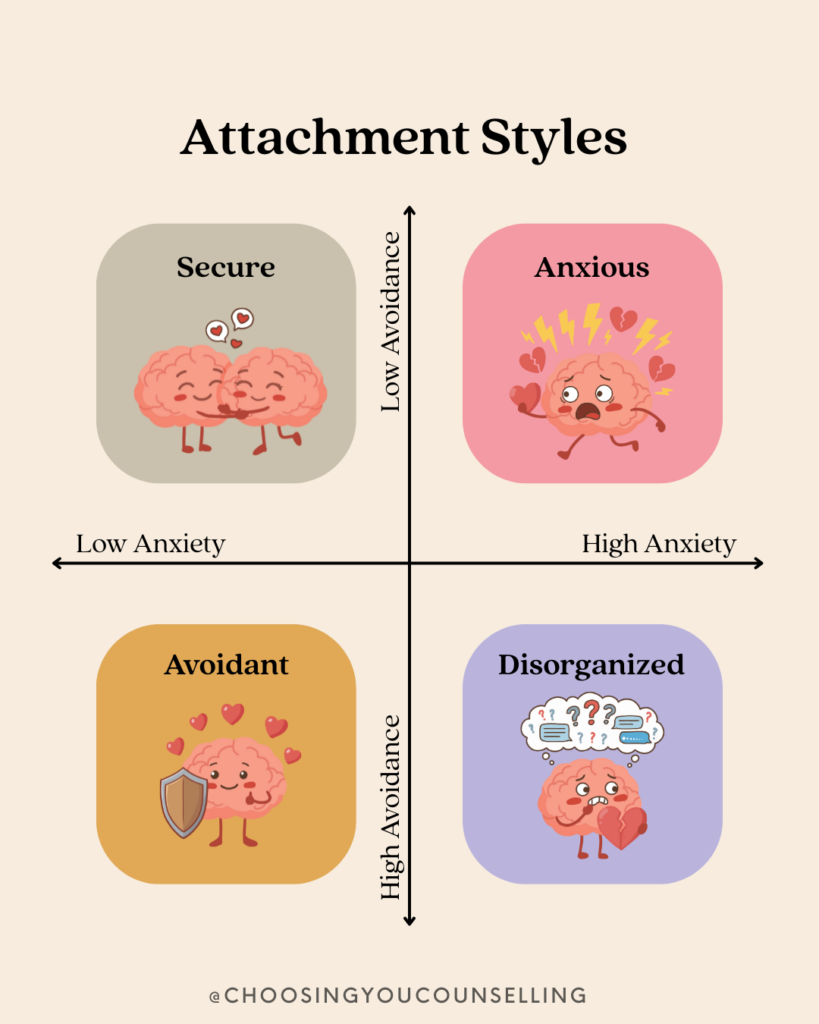
The Four Main Attachment Styles
1. Secure Attachment
Adults with a secure attachment style tend to:
- Feel comfortable with intimacy and independence
- Communicate their needs clearly
- Trust others while maintaining healthy boundaries
- Recover from conflict effectively
If you’re securely attached, relationships generally feel stable and supportive.
— Comfortable with closeness & distance —
2. Anxious Attachment
Adults with an anxious attachment style may:
- Fear abandonment or rejection
- Seek constant reassurance
- Feel preoccupied with relationships
- Experience strong emotional highs and lows
You might notice heightened anxiety when communication changes or when a partner seems distant.
— Uncomfortable with distance —
3. Avoidant Attachment
Adults with an avoidant attachment style often:
- Value independence to an extreme
- Feel uncomfortable with emotional closeness
- Withdraw during conflict
- Downplay emotional needs
While independence is healthy, avoidant patterns can make deep connection challenging.
— Uncomfortable with closeness–
4. Disorganized (Fearful-Avoidant) Attachment
This style combines both anxious and avoidant traits. Adults may:
- Crave closeness but fear it
- Experience intense emotional responses
- Struggle with trust
- Feel confused in relationships
These patterns are often linked to early relational trauma or inconsistent caregiving.
— Uncomfortable with distance and closeness —
How Attachment Styles Show Up in Adult Life
Attachment patterns often influence:
- Romantic relationship conflict
- Dating anxiety
- Difficulty setting boundaries
- Fear of vulnerability
- People-pleasing or emotional withdrawal
- Workplace stress and conflict
It is also possible to see different attachment styles with different individuals. For example, you may have a secure attachment style with your boss at work but an anxious style with your partner. At work this would look like being comfortable taking on projects independently but also comfortable asking and seeking support as needed. Within your relationship this could look like intrusive thoughts or worries anytime your partner gets busy and is unable to communicate as frequently as you’d like. The good news? Attachment styles are not fixed. With awareness and therapeutic support, adults can move toward developing more secure attachment.
How Therapy Can Help
Attachment-based therapy focuses on helping you:
- Identify Your Patterns: We explore how your early experiences shaped your current relationship behaviours.
- Understand Emotional Triggers: Learn why certain situations activate anxiety, withdrawal, or conflict.
- Develop Emotional Regulation Skills: Strengthen your ability to manage intense emotions and respond rather than react.
- Build Secure Attachment: Through a safe, supportive therapeutic relationship, you can experience a new model of connection—one based on trust, safety, and authenticity.
Individual therapy offers a private, focused space to examine patterns without judgment and at your own pace.
Whether you’re dealing with dating challenges, childhood trauma, or long-standing relationship anxiety, therapy can help you move forward with clarity and confidence.
Signs You Might Benefit from Attachment-Focused Therapy
- Feel stuck in repeated relationship patterns
- Experience jealousy, withdrawal, or fear of abandonment
- Struggle with vulnerability
- Feel emotionally disconnected from others
- Want deeper, more secure connections
Seeking help isn’t a sign of weakness—it’s a step toward healthier, more fulfilling relationships.
Start Your Journey Toward Secure Attachment
Understanding your attachment style can be a powerful turning point. Through therapy, you can develop greater self-awareness, emotional resilience, and relationship confidence.
If you’re ready to explore your patterns and create meaningful change, reaching out is the first step.
Secure attachment is not something you’re born with or without—it’s something you can build.
Here’s an Attachment quiz to start exploring which attachment style you might connect with most.